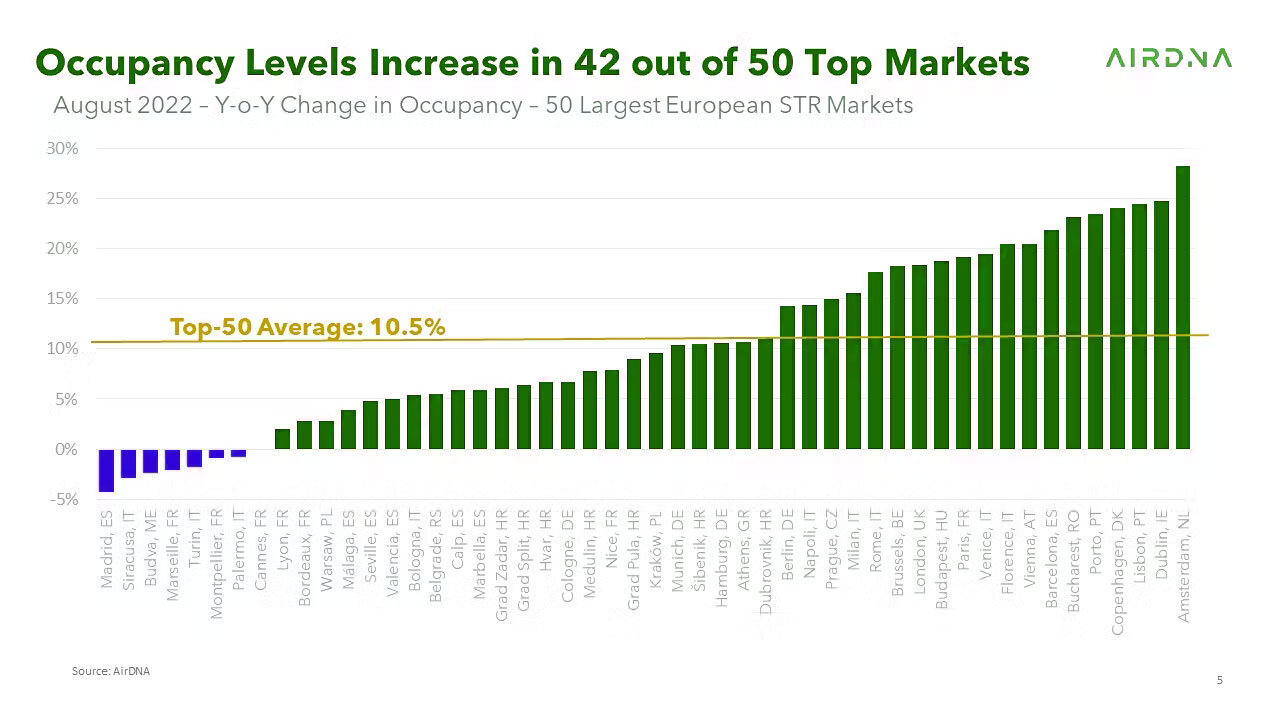
Occupancy rate is one of the key metrics monitored by investors and short-term rental owners. It helps estimate a property's profitability and compare different cities. However, it's not the only factor: purchase price, rental rates, season, and local regulations also play a role. Here's how to calculate it, how to interpret it city by city, and how to improve it.
What is Airbnb occupancy rate?
The occupancy rate, also called the fill rate, is the proportion of days a property (a room or an entire unit) is actually rented, compared to the number of days it is available for rent. It is expressed as a percentage. The closer it is to 100%, the more the property is rented. The closer it is to 0%, the less it is rented.
The vacancy rate complements the occupancy rate: it measures the proportion of time the property remains empty. Both indicators exist for all types of rentals. When looking for figures for your sector, verify that they specifically concern short-term rentals. Data for long-term rentals, for example, for unfurnished properties, are not comparable.
How to calculate the occupancy rate of an Airbnb rental?
The formula is:
Occupancy rate = (number of days rented / number of days available) × 100
Calculation example
A homeowner lists their studio apartment on Airbnb from June 25th to September 4th, a total of 72 available days. During the summer, 14 different guests stay there for a total of 56 nights. The calculation gives: (56 / 72) × 100 = 78. The studio's occupancy rate for the season is therefore 78%.
What a few fewer occupancy points cost
Comparing the occupancy rate to the nightly price reveals the lost revenue. Let's take the same studio, rented for €60 per night regardless of the day or length of stay, over 72 available days:
- Observed rate of 78% : 56 nights rented, i.e. €3,360 in revenue and €960 in lost revenue compared to a property rented permanently.
- Rate of 83% (5 points higher) : 59 nights, i.e. €3,780 in revenue and €780 in lost revenue.
- Rate of 88% (10 points higher) : 63 nights, i.e. €3,780 in revenue and €540 in lost revenue.
- Rate of 100% : 72 nights, i.e. €4,320 in revenue.
For a simple studio apartment and a single summer season, the difference can already reach several hundred euros. Occupancy rate is therefore a key factor in calculating a rental investment.
Airbnb occupancy rates by city in France
Which French cities have the best occupancy rates? Here is the top 10 published on this blog in September 2022, based in particular on Airbnb statistics (measurement period not specified):
- Montpellier: 60%
- Bordeaux: 58%
- Bayonne: 58%
- Lyon: 57%
- Marseille: 57%
- Toulouse: 56%
- Anglet: 53%
- Biarritz: 50%
- Paris: 48%
- Strasbourg: 48%
These figures should be interpreted with caution.
- They are outdated and the market may have evolved since then.
- These are averages that encompass all rentals in each city. From one property to another, the rate varies considerably.
- They do not take into account either the season or the prices charged, which must be studied separately.
A city not included in this ranking may be perfectly suitable for a short-term rental project. Each project is different and deserves a customized study.
How to estimate the occupancy rate of your city?
Platforms like AirDNA or Horiz.io provide data on a city's market: occupancy rates, average prices, and number of listings. These tools aren't sufficient on their own, but they provide a concrete basis for assessing expected profitability and the level of competition. For a figure tailored to your property, you can also... estimate your rental income with a concierge service from the YourHostHelper network.
Airbnb statistics in Nice: occupancy rates, prices and revenue
Nice is a good example of a city where short-term rentals operate year-round. The figures below come from AirDNA data cited in our article published in April 2023 (measurement period not specified). They provide an order of magnitude, not a current picture.
Accommodation supply and types
- Approximately 6,000 active listings on Airbnb, not counting other platforms or inactive listings.
- Nearly 90% are entire homes and about 10% are private rooms in private homes. The rest are shared rooms.
- Approximately 70% of the apartments are studios or one-bedroom units. Two-bedroom apartments represent 24% of the available housing stock. Larger apartments are rare.
Prices and occupancy rates vary by season.
- Average price of around €113 per night, with a peak of around €129 in August and around €103 in February.
- Average occupancy rate of 80% over the year, with a low point of 43% in January.
According to the YourHostHelper agency in Nice, prices rise sharply in summer but do not necessarily fall in winter, because the city hosts many events throughout the year, such as the Carnival in February.
How much does an Airbnb earn in Nice?
The average monthly income from short-term rentals in Nice was €1,637. This amount includes the nightly rate as well as cleaning and other service fees. It ranged from €882 in January to €2,568 in August, nearly tripling.
Facilities and neighborhoods
- Most common amenities: kitchen (96% of homes), internet connection (93%) and heating (90%).
- Only 21% of accommodations offer parking and 7% a swimming pool. The YourHostHelper agency in Nice explains that parking is difficult in the city.
- Rental properties are concentrated in the city center and Old Nice, two central districts close to the sea. The Jean-Médecin and Port districts also have many, as does the seafront up to the airport. More distant neighborhoods have fewer rentals, and these are more often houses.
Do you have accommodation in Nice? Our concierge in Nice can study its potential for short-term rentals.
Which cities should you invest in with Airbnb? 6 criteria
Occupancy rates alone are not enough to choose a city. Here are the criteria to consider before investing.
1. Tourist and professional appeal
Cities that receive a large number of tourists or business travelers offer strong potential. A city that attracts both types of travelers is less dependent on the season. The YourHostHelper agency in Lyon, for example, observes that the city welcomes both tourists and business travelers, thus ensuring year-round occupancy. Conversely, a destination that caters solely to tourists often experiences off-peak seasons.
2. Access and transport
A train station, an airport, good public transport, shops, and restaurants make a city more attractive for short stays. Many travelers arrive by train, plane, or carpool and need a destination with good transport links. Those arriving by car appreciate the proximity of a motorway or highway.
3. Local supply and competition
Analyze the number and quality of Airbnb listings to gauge the competition. A highly sought-after, even saturated, city can still be attractive if the location and type of property are well-chosen. In a less saturated but developing area, a property can quickly stand out. Conversely, if there are almost no short-term rentals in a particular area, it's often a sign of low demand.
4. Regulations
The rules governing short-term rentals vary considerably from city to city. Some municipalities limit the number of rental days per year or require permits. Local authorities closely monitor the impact of short-term rentals on housing. Check local regulations before buying.
5. Profitability and price per square meter
Compare the purchase price with the nightly rental income the property can generate. A precise calculation of the return on investment will help verify that the investment is sound. For the method, see our article on the Airbnb profitability calculation.
6. The evolution of real estate prices
In a growing city, rising property prices can add to rental income and improve long-term return on investment.
Finally, don't limit your search to the city where you live. Having your accommodation nearby is reassuring and simplifies management, but the best location for short-term rentals is sometimes elsewhere.
How to improve your occupancy rate?
Once the property is purchased, several levers can be used to fill more of the calendar.
Pay attention to the advertisement and its visibility.
List your property on multiple booking platforms, such as Airbnb, Booking, or Abritel. Before going live, take great photos and write a detailed description that helps travelers imagine themselves staying there.
Set an appropriate price
Look at the prices of comparable properties in your city and adjust your rate accordingly. Market tracking tools, like AirDNA, can help you monitor trends and set an appropriate price.
Offer good equipment
Wi-Fi, air conditioning, well-equipped kitchen: quality amenities make your accommodation more attractive than competing listings.
Adjusting your schedule and rental periods
Rent out your property for short stays during peak periods, then adjust your offering outside of holiday periods. Airbnb rentals also attract business travelers and students for longer stays. The mobility lease, created by the 2018 ELAN law, allows you to rent to students and employees for a period of 1 to 10 months. This is a way to fill your property year-round.
Enhancing the traveler experience
Traveler reviews are very important on Airbnb. Positive reviews reassure future guests, and the platform highlights highly rated listings. On Airbnb, Superhost status gives a listing more visibility. To get good reviews:
- Respond quickly to requests and provide all relevant information;
- deliver a clean and well-maintained property;
- add a welcome message, tips about the city or a list of good places to eat;
- Invite travelers to leave a review after their stay.
To be accompanied by a concierge service
A concierge service can handle all the management: creating and updating listings, welcoming guests, conducting check-in/check-out inspections, cleaning between stays, and restocking supplies. The agencies in the YourHostHelper network know their local market and can tell you what your property can earn. To get started, Request an estimate of your rental income.