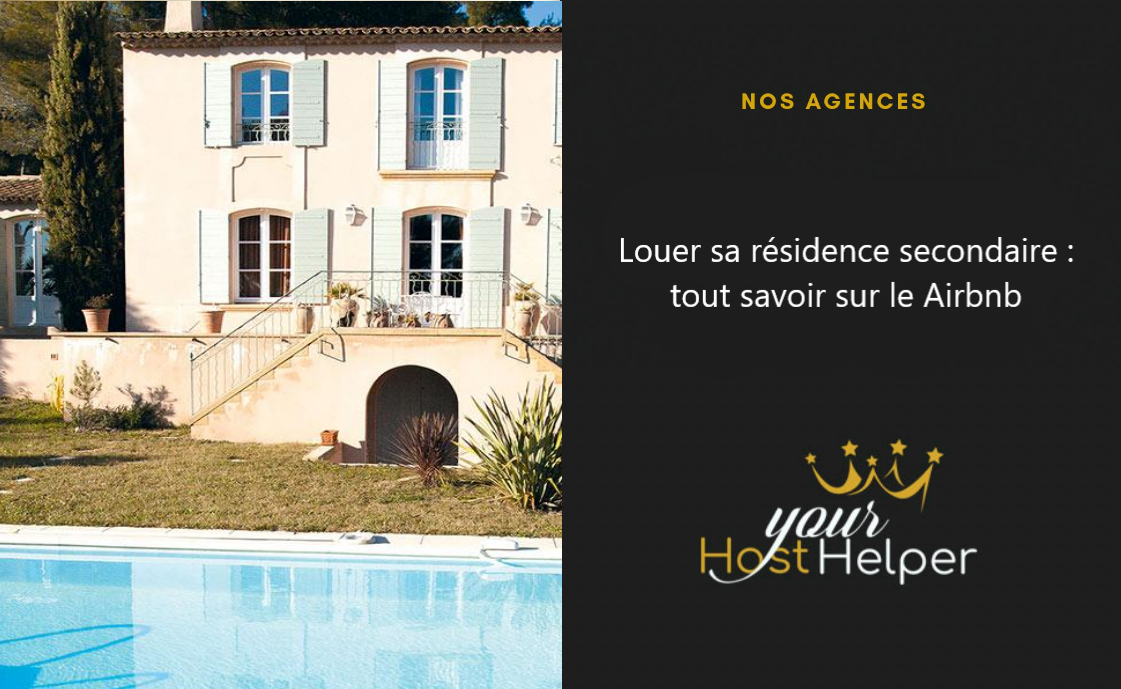
A second home often remains empty for a good part of the year, while the expenses continue to accrue. Renting it out for short stays on Airbnb allows you to generate income without giving up enjoying it. However, you need to know which rules apply: they are not the same as for a primary residence, and they depend in part on the municipality.
Primary residence or secondary residence: what changes when renting?
A main residence is an occupied dwelling at least 8 months a yearExcept for professional obligations, health reasons, or cases of force majeure, a dwelling that you occupy for a shorter period is not your primary residence.
The distinction is important because the limit on the number of rental days only applies to primary residences. In municipalities that require a declaration, a primary residence cannot be rented for more than 90 to 120 days per calendar year, depending on the municipality. Since January 1, 2025, the law of November 19, 2024, allows municipalities to reduce this limit from 120 to 90 days.
A second home does not have this annual limit. However, it may be subject to more complex procedures, such as a change of use (see below).
Do you want to rent out a studio apartment or an outbuilding attached to your main residence? This situation has its own specific rules: we explain them in our article on the rental of annexes to the main residence.
Why rent out your second home on Airbnb?
Additional income without giving up enjoying it
Rather than leaving the property unoccupied, you rent it out when you're not there. You remain free to set your rates, choose rental periods, and block out the dates when you want to occupy it yourself or lend it to friends and family.
High season offers the highest rates, but mid and low season can also generate additional income.
Cover the housing costs
A second home incurs year-round costs: maintenance, local taxes, and potentially a mortgage. Rental income can cover all or part of these expenses. Note: property tax on the second home remains payable even if you only use the property for a few days a year.
Maintaining control over reservations
You accept or decline requests based on your availability and criteria. If you entrust the management to a concierge service, they will implement the instructions you give them.
Airbnb also offers protection for hosts in case of damage caused by guests. Check its terms and conditions and what your own home insurance covers.
For the rules and procedures specific to a second home, consult our guide. Renting out your second home on Airbnb.
Before we begin: the checks
If you are a tenant of the accommodation
A tenant cannot sublet without the landlord's permission. Without this permission, they risk having to return any rent received, paying damages, and having their lease terminated.
If the property is in a co-ownership
Consult the condominium bylaws. A clause restricting residential use to residential properties prohibits any professional activity, including short-term tourist rentals. Since November 21, 2024, new bylaws must specify whether short-term tourist rentals are permitted. Existing bylaws can also be amended by a two-thirds majority vote to prohibit them in residential units that are not primary residences.
If you are renting, you must inform the building manager.
The steps to rent legally
The declaration and registration number
Renting out furnished tourist accommodation must be declared to your local town hall or the online service it designates. Once a registration number (13 characters) is issued, it must appear on each of your listings, including those on online platforms, and be provided to the building manager if the property is part of a condominium.
The change of use
In Paris, the inner suburbs (Hauts-de-Seine, Seine-Saint-Denis, Val-de-Marne), and municipalities with more than 200,000 inhabitants, renting furnished tourist accommodation requires a change-of-use permit issued by the town hall. Since November 21, 2024, other municipalities can also require this permit by resolution.
Depending on the municipality, the permit may be permanent, permanent with compensation (in which case other premises must be converted into housing), or temporary. In mainland France, the application must include an energy performance certificate rated from A to E; from 2034, a rating of A to D will be required.
Registration in the Sirene directory
Regarding taxes, furnished rentals require registration with the INSEE's Sirene directory, which is free and assigns you a SIRET number. This can be done online through the Business Formalities Portal.
Income taxation
Rental income must be declared, and the tax treatment of it has changed in recent years. We detail the rules in our article. Airbnb and taxes.
The rules vary from one municipality to another: before you start, check with your town hall.
Preparing the accommodation for short-term rental
- A welcoming and uncluttered decorwhich makes you want to book.
- Quality photoswhich show what makes the accommodation special.
- Basic equipment Clean sheets, toiletries, and a fully equipped kitchen are essential. The accommodation must be comfortable, regardless of the number of guests or the length of their stay.
- Responsive communication Quick responses, information about the area, and problems resolved quickly. That's what makes for good reviews, and good reviews lead to future bookings.
Managing remotely: entrusting your second home to a concierge service
Short-term rentals require a significant time commitment: welcoming guests, conducting check-in and check-out inspections, cleaning between stays, and managing the calendar. These tasks are repeated several times a month, sometimes weekly during peak season. And a second home is rarely located in the city where you live.
A local concierge service takes care of these tasks for you: posting listings, scheduling according to your instructions, welcoming guests, cleaning, and responding to any issues. You continue to reserve the dates you wish to stay in the property.
To find out what your second home could earn, Request an estimate of your rental income.
F.A.Q
Does the 120-day limit apply to a second home?
No. The limit of 90 to 120 days per year, depending on the municipality, only applies to primary residences. Secondary residences, however, may be subject to a change-of-use permit.
Can you rent out your second home all year round?
There is no annual limit for renting a second home. However, a single client cannot rent the property for more than 90 consecutive days per calendar year.
What are the conditions for renting out your second home on Airbnb?
You must have the right to rent (owner's permission if you are a tenant, condominium regulations that do not prohibit it), declare the accommodation, display the registration number on the advertisement if there is one, obtain the change of use if the municipality requires it, and register in the Sirene directory.